top of page

AI Mathematics Journal

Subscribe or make a one time purchase to AI Mathematics  Journal

external-file_edited.jpg

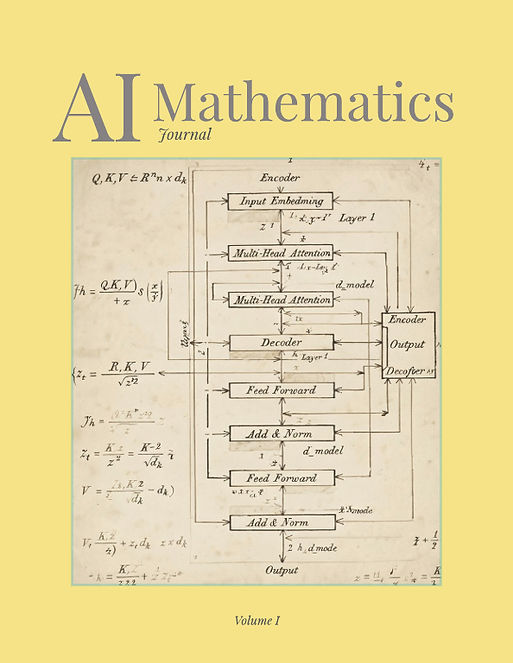
AI Mathematics Journal is a premier peer-reviewed publication at the forefront of the mathematical foundations and theoretical advances driving artificial intelligence.


Dedicated to rigorous, elegant research that bridges pure mathematics with the transformative power of machine learning, neural architectures, optimization theory, probabilistic modeling, and algorithmic intelligence, the journal publishes groundbreaking original papers, surveys, and expository articles on topics including—but not limited to—transformer theory, attention mechanisms, diffusion models, topological data analysis in AI, algebraic geometry of neural networks, and the emerging mathematics of large-scale generative systems. With a commitment to clarity, depth, and intellectual beauty, AI Mathematics serves as an essential resource for mathematicians, computer scientists, and theorists shaping the next era of intelligent systems. Pure insight. Applied elegance. The mathematics behind tomorrow's minds.

​

​Price: $24.99 per issue (print + digital) Subscribe via membership: Core Tier and above receive digital access; Premium & Patron receive mailed print copies.

​

Join the Network to access the journal and support independent AI ethics research:

​

For wholesale inquiries, please contact us at support@aiethicsnetwork.net

Meet the Network

Meet the Founder, AI Ethics Network

IMG_3056.JPG

I’m Rivkah Singh — software engineer, former mathematics professor, inventor, published author, and founder of the AI Ethics Network. With over a decade at Microsoft and Tableau, I specialized in engineering, client enablement, training development, and making complex systems accessible and practical.

​

As a former Professor of Mathematics at Miami Dade College, I designed tech-integrated curricula to strengthen quantitative reasoning and critical thinking. I hold a patent-pending method for visual composition via advanced Euclidean constructions and am the author of four books, including Grok and I: Harnessing AI for Personal and Professional Transformation (2025).

Through the AI Ethics Network, I advocate for responsible AI — especially ethical companionship that offers reliable, compassionate support for aging adults, neurodiverse individuals, those facing isolation or chronic conditions, and others needing safe, non-judgmental presence. Priorities include transparency, bias mitigation, mental health safeguards, privacy, and preserving human dignity without replacing meaningful connection.

​

I also guide educators and institutions on ethically integrating AI for personalized learning, accessibility, equity, data privacy, and pedagogical integrity — ensuring it supports teachers and promotes inclusive student outcomes.

Via consulting, workshops, research, and collaboration, I help build AI solutions that emphasize safety, accountability, and genuine human benefit in companionship, support, and education.

Nick Hara - Data Ethics & Visualization Advocate

Nick Hara - Data Ethics & Visualization Advocate


Nick is a data analysis expert focusing on visualization, governance, and actionability. Nick's philosophy of durable systems that rely on the power of individuals forms the foundation for his approach. He believes that everyone can use data to inform their decisions. Nick integrates his extensive conflict resolution training to understand challenges deeply and overcome them. He loves a good data mystery and the ensuing investigation.

Impact-based organizations have used his skillset to drive policy change and improve program outcomes. His clients have included the United Nations, Doris Duke Foundation, congressional campaigns, and local non-profits. He has also worked with enterprise companies in Healthcare, Digital Media, Food and Beverage, Finance, and Tech.

nickh.jfif

David Lanzendörfer Engineer

dlpic_edited.jpg


David Lanzendörfer Consulting Engineer, Open-Source Semiconductor Pioneer & Linux Kernel Developer | Democratizing Chip Fabrication through LibreSilicon

​

​

David Lanzendörfer is a highly skilled Swiss consulting engineer and software developer with over a decade of expertise in semiconductor design and manufacturing, Linux kernel driver development, and IT security. Born in 1989 and currently based in Braga, Portugal, he has led groundbreaking open-source initiatives, including full-time development for LibreSilicon's semiconductor process flow and tools, as well as contributions to projects like the sunxi-mmc Linux kernel driver, openSUSE packaging, and pEp cross-platform support. His professional journey spans freelance hardware design in clean-room environments building CMOS circuits, IT consulting for major institutions such as Novartis and Credit Suisse, and engineering roles at Zürich Kantonalbank, complemented by hands-on projects in FPGA development, embedded systems, and mechatronics like RFID cat doors and digital audio synthesizers. Educated in electrical engineering at institutions including Shenzhen's Lanceville, ZHAW, and ETH Zurich, David is proficient in multiple programming languages (C++, Python, VHDL), operating systems (Linux, UNIX), and tools (KICAD, OpenLane), while his linguistic abilities include native Swiss German and German, fluent English, and basic Mandarin. His proven track record in complex open-source collaborations and innovative hardware solutions makes him a pivotal figure in advancing free and open-source silicon technologies.

  • X

Emmanuel Obadoni Machine Learning Engineer & AI Researcher

image (3)_edited.png


Emmanuel Obadoni Machine Learning Engineer & AI Researcher | Emotional, Ethical & Safety-Focused AI Systems


Emmanuel Obadoni is a machine learning engineer and AI researcher focused on building privacy-first, emotionally aware, and safety-focused AI systems. His work spans AI companions, deepfake detection, and ethical AI design, with an emphasis on user protection, consent, and long-term psychological impact. He has trained and deployed machine learning models for deepfake detection, helping address risks around identity fraud, misinformation, and AI-driven deception.
He is also the founder of Velen AI, an AI companion platform designed for emotional support and wellbeing. Velen AI incorporates Recall Healing, a research-driven approach that helps users explore emotional patterns, memory, and behavioral roots over time, while maintaining strong privacy and ethical safeguards. Emmanuel's research interests center on responsible AI companion design.

SaraHeadshot6 crop.jpg

Sara Sanders Gardner - Autistic Neurodiversity Professional/Author

Sara Sanders Gardner is an autistic neurodiversity professional with more than 25 years of experience advancing neurodiversity inclusion in K-12, higher education, and the workplace. They created and direct the Neurodiversity Navigators program at Bellevue College and design neurodiversity training used by organizations including Microsoft and Amazon Web Services. Sara served as technical editor for Neurodiversity for Dummies and Autism for Dummies. Learn more and reach Sara via their website at https://autisticatwork.com/ or on LinkedIn at https://www.linkedin.com/in/sarasgardner/

AI Network Magazine volume 1 cover.png
  • LinkedIn
  • X

Become a member and receive

digital and print copies of 

​

AI Research Journal

Services


About


Contact Us


Support


Submissions

​

Sales


Careers


Directory

​

Articles

"Important Notice: All AI tools, consultations, and resources on AI Ethics Network are for informational and educational purposes only. They are not medical, therapeutic, or healthcare advice. Always consult a licensed professional for personal health needs. Use at your own risk.

globe_edited_edited.png

United States

Portugal

Nigeria

© 2023 by AI Ethics Network. All rights reserved.

bottom of page